Small business scheme in Germany 2026 (Kleinunternehmerregelung): thresholds, pros and cons, invoice
The German small business scheme 2026 under § 19 UStG: thresholds €25,000 and €100,000, the founding year, what happens when you exceed them, pros and cons – and a sample invoice with the mandatory details.
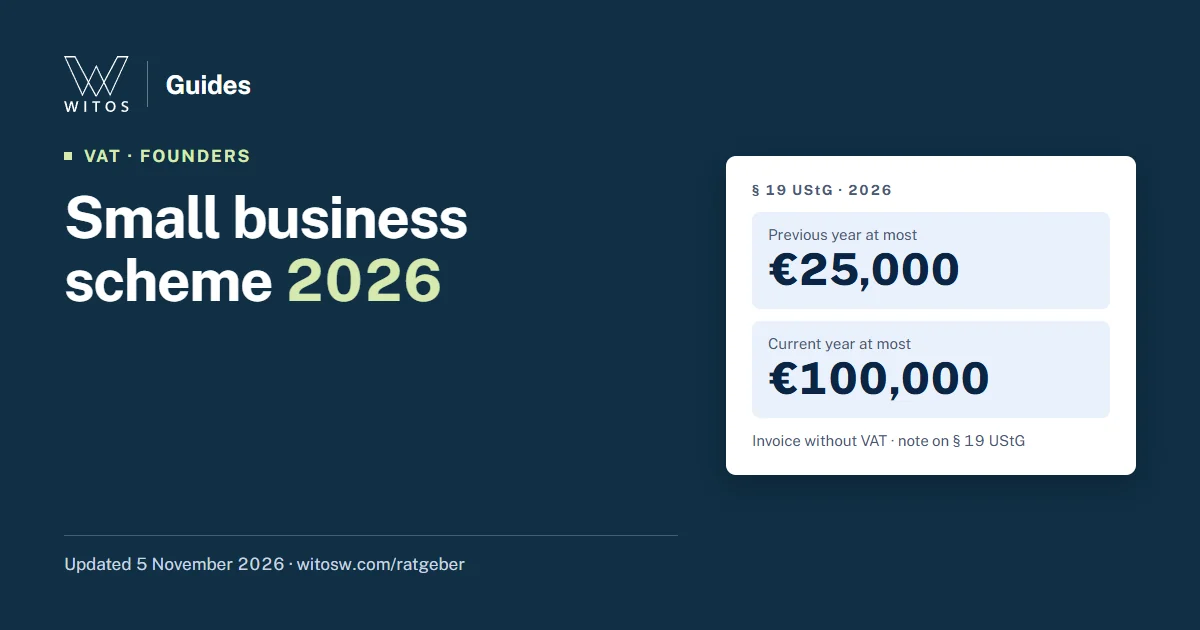
As a small business (Kleinunternehmer) you issue invoices without VAT and, as a rule, do not file VAT advance returns. New rules have applied since 2025 – with thresholds many people get wrong. This guide explains the position in 2026 with quotes from the law and the Federal Ministry of Finance (BMF), the pros and cons, and shows a sample invoice.
The thresholds: €25,000 and €100,000
Under § 19(1) UStG your turnover is exempt from VAT “if the total turnover … did not exceed €25,000 in the previous calendar year and does not exceed €100,000 in the current calendar year”. For 2026 this means: turnover in 2025 at most €25,000 and turnover in 2026 at most €100,000.
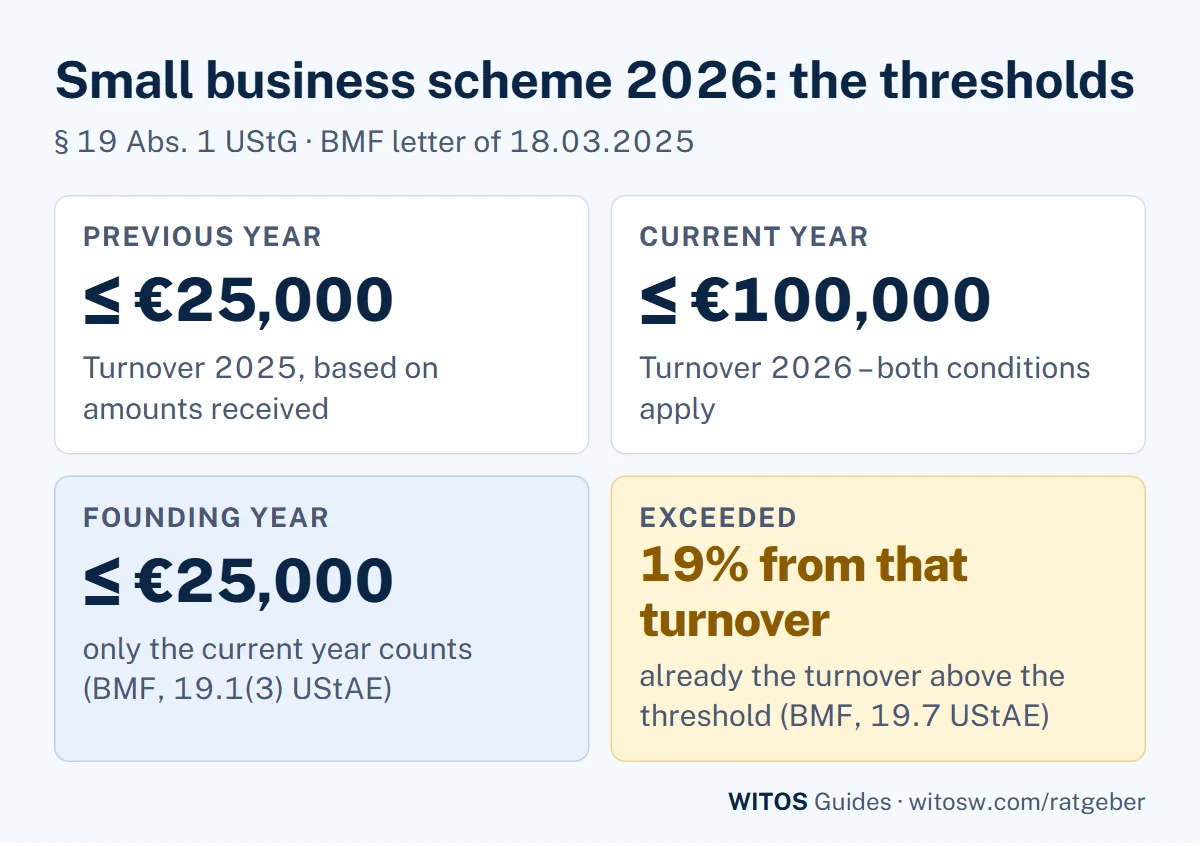
- Total turnover is the “sum calculated on the basis of the consideration received” (§ 19(2) UStG) – what counts is what you actually receive in the year. Sales of fixed assets, such as your old business laptop, are not included.
- In the founding year only one threshold applies: if the business starts during the year, “only the actual domestic total turnover … of the current calendar year” counts, and with “the threshold of €25,000 and not the threshold of €100,000” (BMF letter of 18 March 2025, section 19.1(3) UStAE, German). So the actual turnover counts, not an estimate.
- If you exceed a threshold, the exemption ends within the same year: if the €100,000 threshold (€25,000 for a new business) is exceeded in the current year, “the turnover received that exceeds the respective threshold is already subject to standard taxation” (BMF letter, section 19.7 UStAE). From that turnover on you charge regular VAT, as a rule 19% (§ 12(1) UStG).
Example: Lea starts her business on 1 March 2026. By October she has received €22,000. If a payment of €4,000 arrives in November, that payment takes her over the €25,000 of the founding year – this very turnover is already subject to VAT. Had she received €24,000 in total in 2026, she would remain a small business in 2026 and could stay one in 2027 as long as she does not exceed €100,000 in 2027.
What the scheme means
- As a rule, no VAT returns: the rules “on the filing obligations (§ 18(1) to (4))” do not apply; “§ 149(1) sentence 2 of the Fiscal Code and § 18(4a) of this Act remain unaffected” (§ 19(1) sentence 2 UStG) – so as a rule no advance returns and no annual VAT return. The tax office may still ask you to file in an individual case (§ 149(1) sentence 2 AO). Exception: if you buy services from businesses abroad – for example online advertising or software from a provider in another EU country – you may owe the VAT on them yourself (§ 13b UStG) and have to declare it (§ 18(4a) UStG; BMF letter, section 19.1(1) UStAE). In an individual case, ask a tax adviser. The income tax return remains.
- No VAT on the invoice: according to the IHK filling aid for the questionnaire, anyone using the scheme “may not issue invoices with separately shown VAT”.
- No input VAT deduction: “a business is not entitled to deduct input VAT on purchases” used for exempt small business turnover (BMF letter, section 15.2 UStAE). So you do not get back the VAT on your purchases.
Pros and cons
| Pros | Cons |
|---|---|
| Less paperwork: as a rule no advance returns, no annual VAT return. | No input VAT deduction – on large purchases (laptop, tools, car) you bear the VAT yourself. |
| Cheaper for private customers: your price contains no 19% VAT. | Business customers gain nothing – they could deduct your VAT as input tax anyway. |
| Simple invoices (mandatory details under § 34a UStDV, see below). | You have to keep an eye on the thresholds; if you exceed them, you switch in the middle of the year. |
You can waive the scheme: “irrevocably” towards the tax office, by the end of February of the second following year; the waiver “binds the business for at least five calendar years” (§ 19(3) UStG). Whether this pays off depends on your customers and investments – for your individual case, ask a tax adviser.
The invoice as a small business
An invoice for exempt small business turnover must contain “at least” the following under § 34a UStDV:
- the full name and address of you and of the customer,
- your tax number or your VAT identification number or small business identification number,
- the date of issue,
- quantity and type of the goods, or scope and type of the service,
- the amount in one sum “with a note that the small business exemption applies to the supply or service (§ 19 of the Act)”.
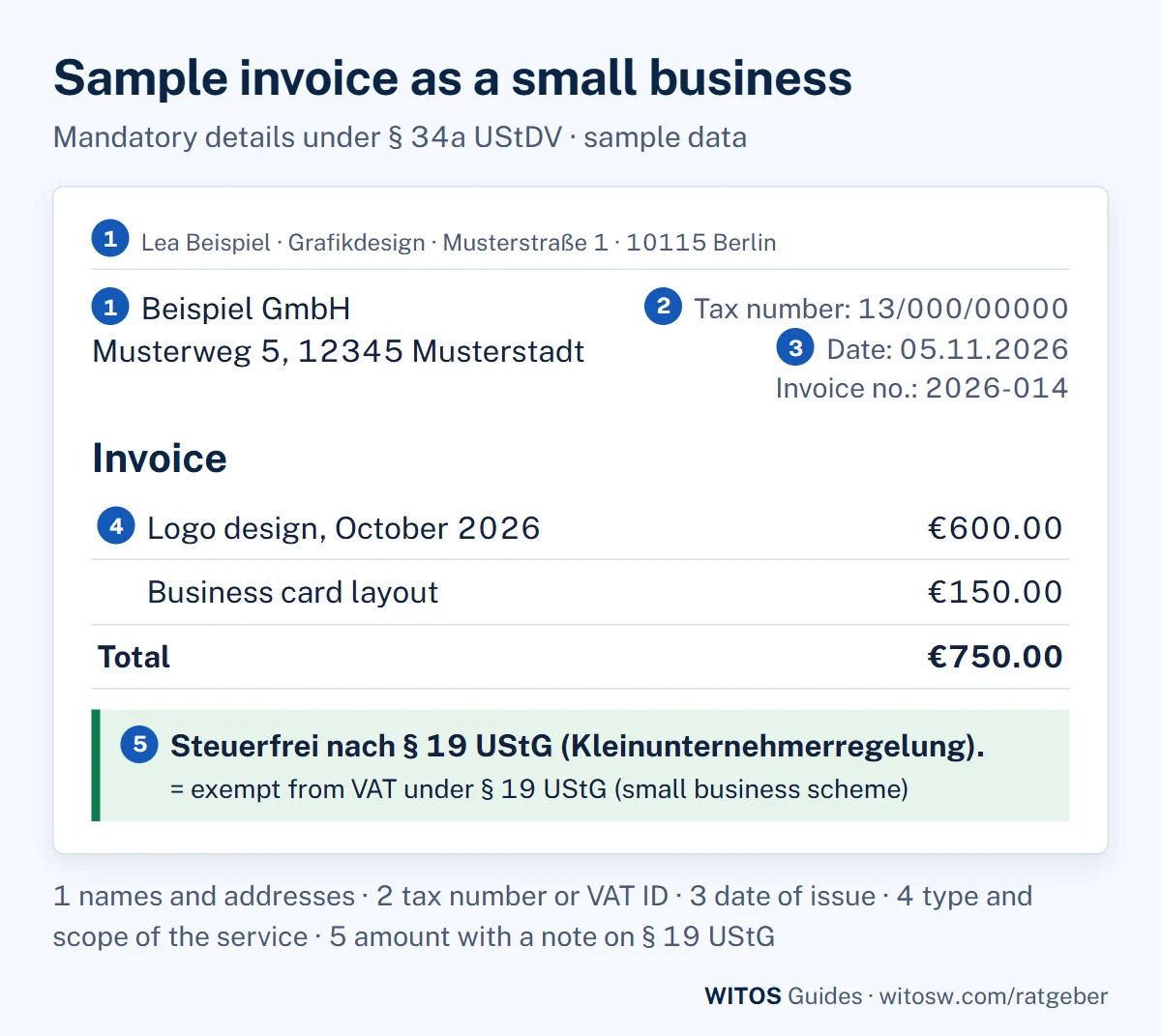
A possible note: “Steuerfrei nach § 19 UStG (Kleinunternehmerregelung)” – exempt from VAT under § 19 UStG (small business scheme). § 34a UStDV does not mention a sequential invoice number; many people use one anyway because it keeps the bookkeeping in order.
E-invoices: issuing no, receiving yes
Your invoice “can always be transmitted as another invoice” (§ 34a sentence 4 UStDV) – for example as a PDF or on paper. You do have to receive e-invoices, though: “Small businesses are exempt from issuing e-invoices …, but must still be able to receive e-invoices.” For that, “an e-mail inbox is already sufficient” (BMF: FAQ on e-invoices, German).
How to choose the scheme
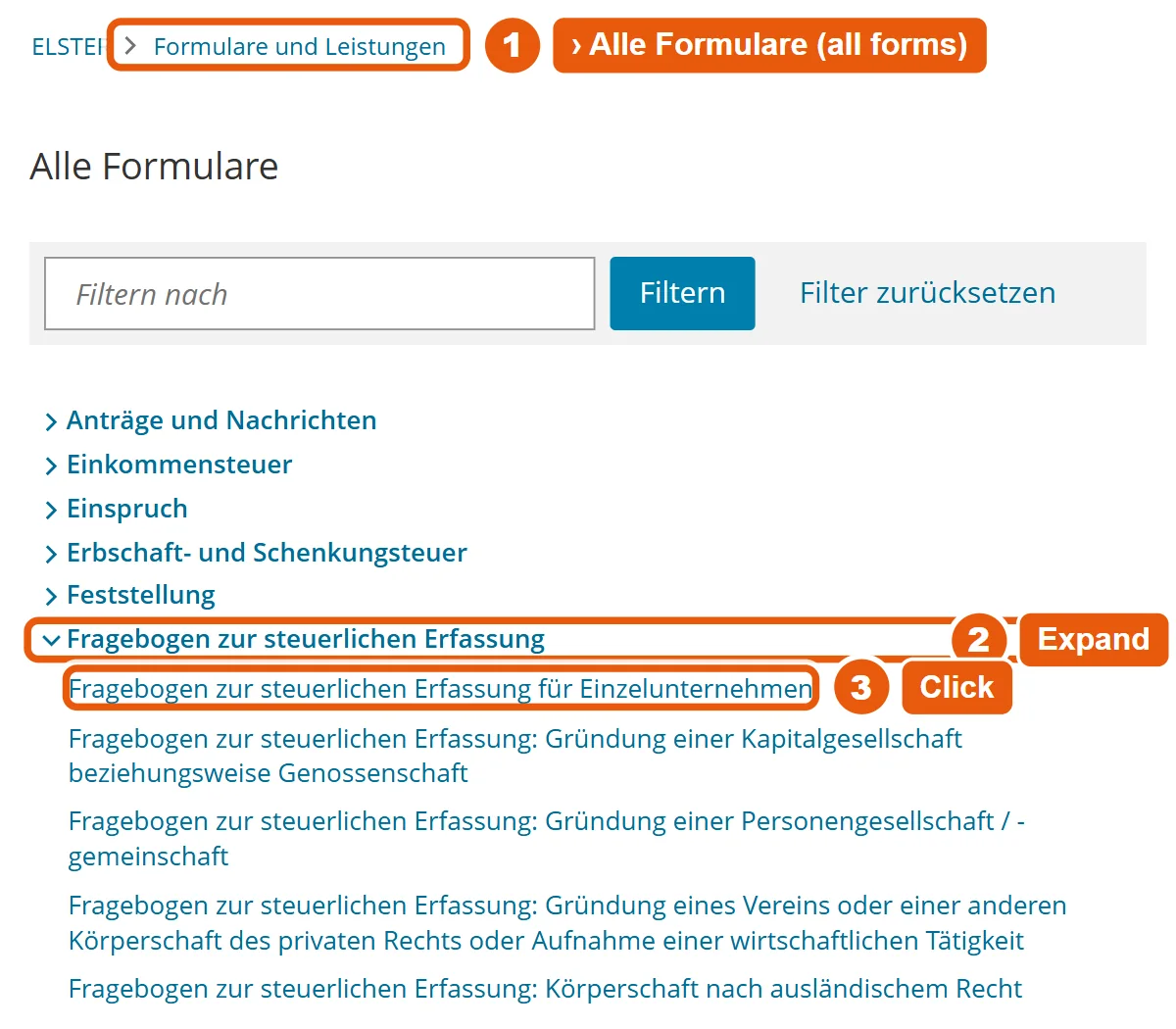
You make the decision in the tax registration questionnaire, which you send via ELSTER within one month of starting. Click path: elster.de → Formulare und Leistungen → Alle Formulare → “Fragebogen zur steuerlichen Erfassung” → the form for your legal form → after logging in, state the small business scheme in the VAT section.
Summary
- Previous year at most €25,000, current year at most €100,000 – in the founding year €25,000 in the current year.
- What counts is what you actually received.
- Whoever exceeds the threshold charges VAT from that turnover on.
- No VAT on invoices, no input VAT deduction, as a rule no advance returns (exception: § 13b UStG for services from abroad).
- Invoice with a note on § 19 UStG; be able to receive e-invoices.
General information, not legal advice for your individual case. The linked official sources and the competent authority are authoritative.
Need a business address in Berlin for this? How the WITOS business address works →