Imprint without your home address: how to protect where you live
Does your home address have to be in the imprint? What § 5 DDG requires, why a PO box and a block in the population register do not help, and which options exist – with examples, risks and a checklist.
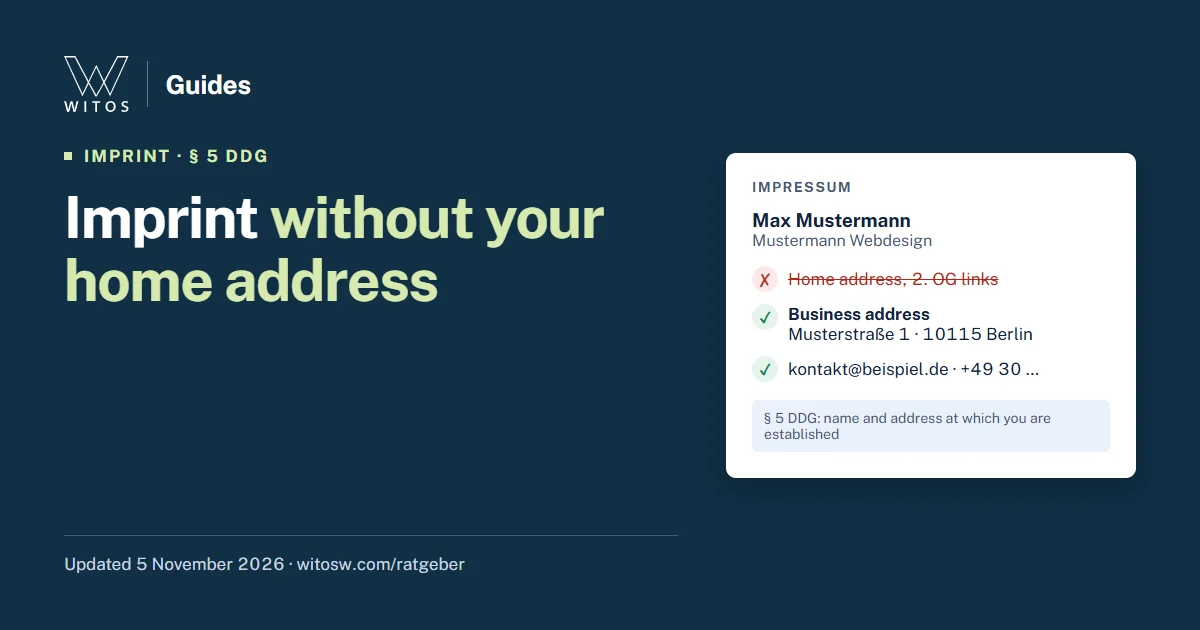
If you run a website, an online shop, a shop on Amazon, eBay or Etsy or a channel on a business basis in Germany, you need an imprint (Impressum) – and it contains an address anyone can read. Many self-employed people do not want to show their home address there. This guide explains what the law requires, what does not work and which options exist – including where lawyers disagree.
What the law requires
The imprint obligation is set out in § 5 of the Digital Services Act (DDG). Providers of digital services offered on a business basis, usually for payment, must keep certain information, which must be easily recognisable and directly accessible, permanently available. First of all:
“the name and the address at which they are established, for legal persons also the legal form and the authorised representative …” (§ 5(1) no. 1 DDG)
This is followed, among others, by an e-mail address and another fast way to get in touch (no. 2), for companies the register and register number (no. 4), and a VAT or business identification number if you have one (no. 6). A missing or wrong mandatory detail is an administrative offence; § 33 DDG provides for a fine of up to €50,000 (para. 2 no. 1, para. 6 no. 3). With a wrong address you also risk “warning letters and fines” (“Abmahnungen und Bußgelder”, eRecht24).
In practice people speak of an address for service (ladungsfähige Anschrift): a complete address with street, house number, postcode and town where you can be reached and where documents can be effectively served (eRecht24: address for service).
What does not work
- A PO box. The Regional Court of Traunstein did not accept a mere PO box number in an imprint; what is required is “a complete address for service of the provider” (LG Traunstein, ref. 1 HK O 168/16, summarised by IT-Recht Kanzlei).
- Only an e-mail address or a contact form. § 5 DDG requires a name and an address; the e-mail address comes on top.
- A block on information from the population register. It makes sense if you are threatened or harassed – but it only protects against information from the population register (§ 51 BMG), not against what you publish in your imprint yourself.
- Simply leaving it out. An imprint without an address is incomplete – see above.
Options without your home address
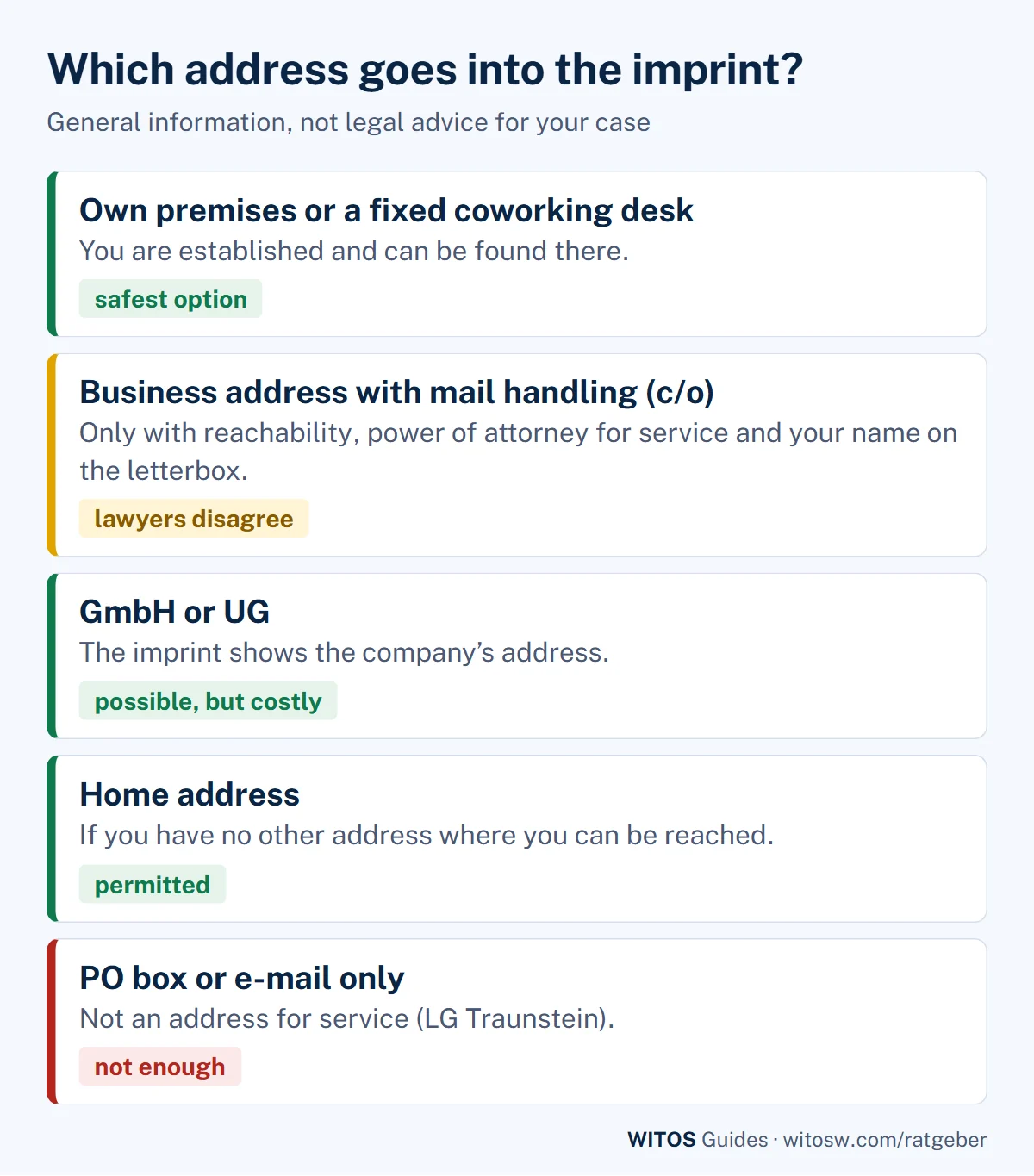
1. Your own business premises or a fixed coworking desk
If you actually work in an office, a workshop or at a rented desk, you are “established” there and can be found there. According to eRecht24, coworking desks also meet the requirements, “since you can actually be found there” – whether you rent a room, an area or just a desk. This is the safest option, but usually the most expensive.
2. A business address with mail handling
Many self-employed people use a business address from a provider, often with “c/o”. Here lawyers do not agree:
- According to eRecht24, a c/o address in the imprint is “generally permitted as long as you can be reached via the address and, for example, post can be delivered” (eRecht24: c/o address in the imprint). For a GmbH’s business address in the commercial register, the Higher Regional Court of Hamm accepted a c/o addition as long as it does not “conceal or fake” the possibility of service (decision of 7 May 2015, ref. 27 W 51/15, also summarised there).
- The same site is stricter about virtual offices: they are “not an address for service”, and even a virtual office with mail handling is “not a legally safe alternative”; what is allowed, however, is an expressly granted power of attorney to receive (Empfangsvollmacht) that entitles the authorised person to accept legally binding declarations (eRecht24: address for service, citing BGH, judgment of 7 July 2023, V ZR 210/22).
If you choose this option, check three things: the provider also accepts formal service of documents for you at the address (with a written power of attorney), your name or company name is on the letterbox, and you learn about every item quickly – court mail comes with short deadlines. For sole proprietors some risk of a warning letter remains; for your individual case, ask a lawyer.
3. Founding a GmbH or UG
If a legal entity is the provider, the imprint shows its name, its address, the legal form and the authorised representative (§ 5(1) no. 1 DDG) – not the managing director’s home address. The company needs a “domestic business address” that is entered in the commercial register (§ 10(1) GmbHG). Founding a company just for the imprint rarely pays off: notary, commercial register, bookkeeping and annual accounts cost money and time.
4. Your home address
If you have no other address where you can be reached, your home address goes into the imprint. Bear in mind as well: the name, business address and activity from the trade registration “may be made generally accessible” (§ 14(5) GewO). If you want to protect your home address, think about which business address you give as early as the trade registration.
How to write the address correctly
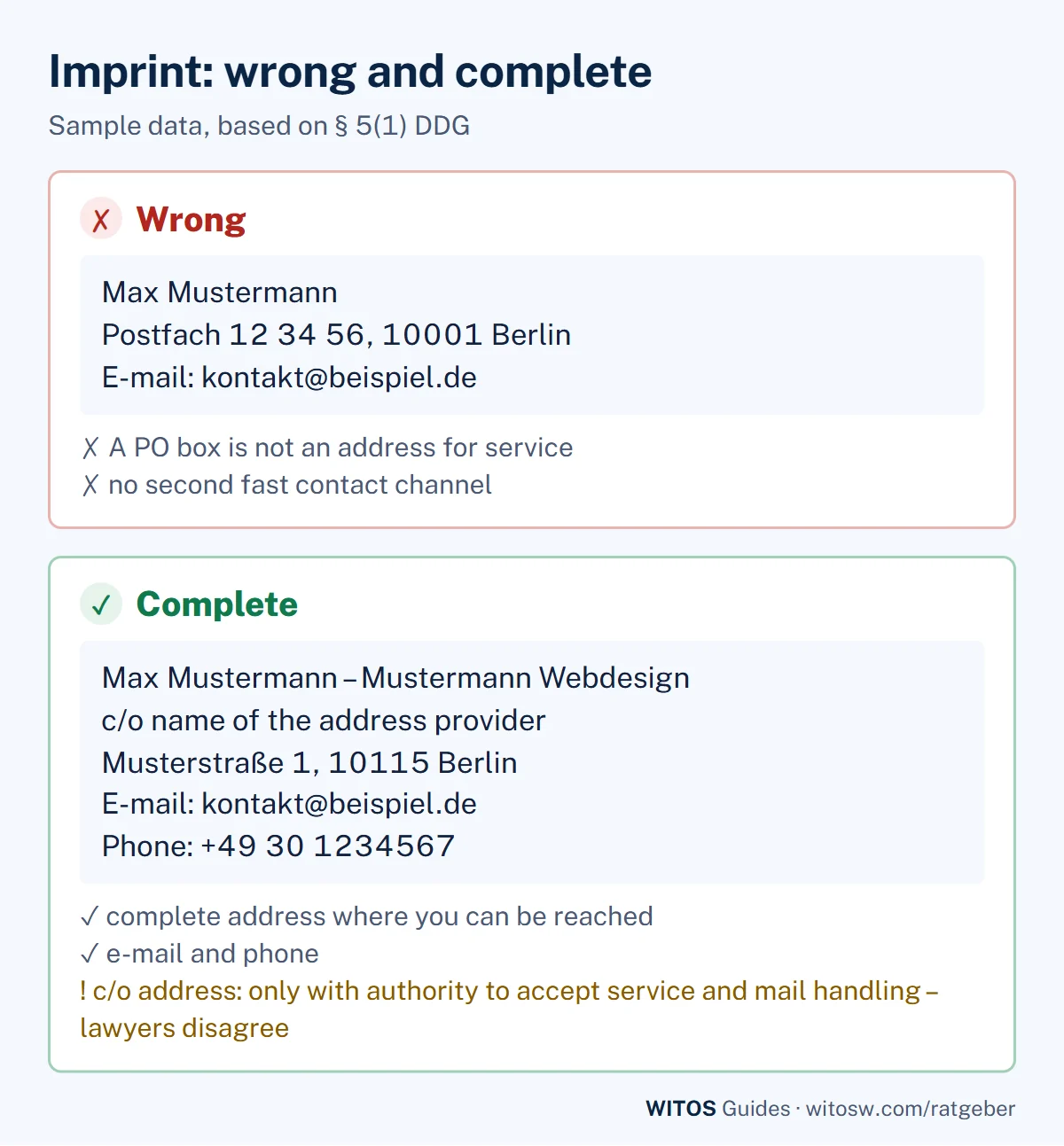
An example for a sole proprietor with a business address:
Max Mustermann – Mustermann Webdesign
c/o name of the address provider
Musterstraße 1
10115 Berlin
E-mail: kontakt@beispiel.de · Phone: +49 30 1234567
And for a GmbH:
Beispiel GmbH
Musterstraße 1, 10115 Berlin
Represented by the managing director: Erika Musterfrau
Register court: Amtsgericht Charlottenburg, HRB 000000 B
VAT ID: DE000000000
The address must be the same and up to date everywhere: in the imprint, on invoices, with the trade office and the tax office. If you move or change your business address, update the imprint on the same day. You still give the tax office your home address – that is not public (see tax registration questionnaire).
Checklist
- Name or company name and legal form complete?
- Street, house number, postcode and town – no PO box?
- Can you be reached at this address, is formal service of documents accepted there and does it reach you quickly?
- E-mail address and a second fast contact channel (e.g. phone)?
- For companies: authorised representative, register court, register number?
- VAT ID or business ID number, if you have one?
- Imprint reachable with one click from every page – also in marketplace shops and social media profiles?
General information, not legal advice for your individual case. The linked official sources and the competent authority are authoritative.
Need a business address in Berlin for this? How the WITOS business address works →